
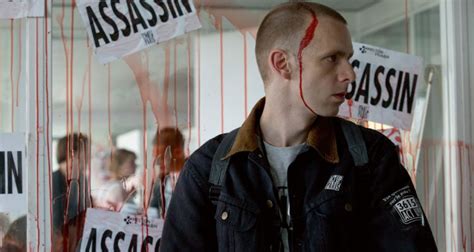
120 Battements par Minute (also 120 Beats per Minute, or 120 BPM) directed by Robin Campillo, was released in 2017 at the Cannes film festival, and was generally well received. The film, set in the early 1990s, focuses on the group ACT UP Paris (Aids Coalition to Unleash Power), a political organization working towards ending the AIDS pandemic. The film’s focus is not so much on historical accuracy, but rather emotional accuracy, conveying the pain and urgency felt at the time. Through this lense, I aim to explore the political weaponization of queer grief.
The first half of 120 BPM has a more general lens on the setting it presents to us, Paris in the 1990s at the height of the AIDS crisis. We’re introduced to ACT UP at the same time as Nathan and two others, and view how the organization holds meetings, delegates tasks, holds protests, and informs their members. Sean is introduced with a controversy, when member Sophie (who was leading a protest at a medical conference of a sort) brings to the table the issue of Sean and some other partners taking drastic measures at the conference. What was supposed to be a routine demonstration is upstaged when someone accidentally throws a blood bag too soon and hits a key speaker in the face with it, and Sean and Max take the opportunity to handcuff the speaker to a pole. The group argues about presentation, respectability, and upsetting others. There are a couple more demonstration/protest scenes that highlight some of the impactful, hard work of Act Up, before the movie shifts its focus on the developing romance between Sean and Nathan. With this shift, we get to see a more in-depth, personal, and affective view of how the AIDS crisis plays out. Sean is HIV-positive (Nathan is not) and they have a couple conversations about HIV, sexual histories, etc. Their relationship develops, as does Sean’s illness. Eventually, Sean goes from an active, involved member, to a vacant version of himself as the disease progresses. He eventually asks Nathan to euthanize him, and dies. Act Up throws his ashes on health insurance conference-goers, as Sean asked before his death. The film ends with this scene transitioning into one of the members of ACT UP dancing at a club.
In one of the beginning scenes of the movie, Act Up storms a Melton Pharm office building (a pharmaceutical company that takes the spot as the main antagonist of the film), throwing blood on the walls and windows. As the police storms in and starts arresting them, the members drop to the floor so that they must be dragged away (and are more of a hassle to arrest). Afterwards, on the train ride home, they complain about the officers, saying that they were held for three hours too many and poking fun at how the police officers wore gloves to handle their bodies, as if they were scared of getting any on them. In this course, when reading Anzaldua, we asked about what place and use queerness has on a community, especially marginalized ones. But in 120 BPM, as seen in this scene, the one with Sophie, and other activism scenes, the question gets turned to “what can the community do for us?” Personally, I’m partial to this question. As with the scene with Sophie and our conversations about the Fun Home musical, I think often within the community (and other marginalized communities) there’s a lot of worries about palatability as a means of getting rights and acceptance. The ‘respectability’ issue comes up often and is sometimes even used as a means to gatekeep. This can be seen in things such as the exclusion of aromantic and asexual individuals, as well as with how we deal with gender identity and pronouns. Anything outside the binary (and therefore, the ‘normal’ order of things) is often discredited, based on the fear that identities and pronouns that are not as mainstream or easily understood/identifiable will make the whole community look ‘unreal’ or as ‘ridiculous’ as these identities can be perceived. I think in part, the problem is that with the idea of ‘respectability’ comes the question -posed by the marginalized community- of “will you allow us to exist in the same space as you?”, which of course comes with all the marginalization, violence, and rejection. In setting respectability aside and asking “what are you doing for us?” this violence doesn’t change, but instead the marginalized people assert their space and demand their dues. That is, in part, what the film shows us ACT UP doing. 120 BPM reminds us of the aggressive, demanding, bold way we’ve demanded what’s due to us. I find this increasingly important, especially with the complacency (or worse, assimilation!) brought about by the legalization of same-sex marriage, which only services part of the large LGBTQIA+ community. It’s a good reminder that the right to marriage is not the only thing we’ve ever fought for, it’s not the only thing we’ve ever wanted or needed, and it’s not the end of us.
After the shift into the more personal/intimate view of the narrative (with the two lovers, Nathan and Sean), there is an increased emphasis on death and loss. This is both in the grander scheme, with both the abstract collective of Paris and unnamed members of Act Up emphasizing their imminent deaths in meetings, and with characters that have been developed throughout the narrative. One of these, a young member named Jérémie who has been in several scenes and whose disease has noticeably progressed, dies at about the halfway mark of the film. He asks for his casket to be carried throughout the streets of Paris so that his death can have political meaning, as well. The cycle repeats with Sean- he noticeably gets worse, more tired, less capable, fragile in a way he has not been presented before. He asks Nathan to euthanize him, and asks that his ashes be thrown at health insurance big-wigs. A heavy sense of loss permeates the film as we watch these characters get sick and die, and although the political use of their deaths seems to accentuate this loss and grief, it also serves as a way of self-imposed melancholia. With these political deaths, the goal is to make it harder to forget these individuals and let their deaths pass by meaninglessly. This opens up an avenue of melancholia not previously explored in this class- that of melancholia weaponized for political gain. Melancholia in queer art is not a new or even a revolutionary subject- often, this is even commodified and capitalized. But in the beginning of the semester when we talked about how ‘happy’ is a narrative that is increasingly and incessantly pushed, and that sometimes there are benefits to allowing oneself to become melancholic, I hadn’t quite understood. However, I’ve since begun to take notice in how a lot of the queer activism I’m present to- a lot of activism in general- weaponizes this grief, bringing it to the forefront and refusing to ignore it. While this can and does become overwhelming, it is also a useful political tool, and I personally prefer this use to that of servicing the straight audience with the ‘beauty’ that is a narrative composed of queer suffering, simply to suffer.
There is strength in being happy; there is strength in being miserable. It’s important, human, to let yourself experience whatever emotions you feel in their fullness. One of the main features of melancholia is the inability to get over something, which we categorize as a negative because we as a society are so focused on moving on and experiencing the ever-fabled happiness. In certain cases, this inability to move on is important and useful; the inability to let go of queer grief, to ‘put behind’ the pain and wrong that has been caused to us by straight society, teaches us lessons on queer history, queer activism, and queer identity. AIDS is not a problem of the past, a problem of the negligible- if the only way that we can draw attention to that is through a refusal to relinquish grief- to force others to share in our grief- then so be it. I liked this film, and it’s execution, but I’d also like if it took a step back and listened to it’s own message– if it paid attention to those of us who must still suffer today.

