
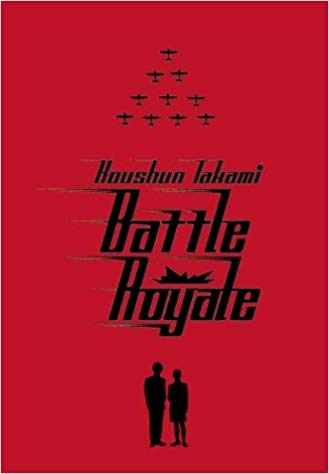
Battle Royale is a dystopian thriller novel that was first published in japan in 1999 and authored by Koushun Takami. A bestseller in its day and a cult classic today, Battle Royale had always been a controversial read, and was consideration of being banned in Japan. I personally came across this novel through sneaking into my uncle’s bedroom, curious to see what I could find. I came across this book, which captivated me with its blood red hue, and the cover, though minimalistic, served to explain that I would expect to find a thriller, as the cover depicted two silhouettes standing side by side, with the outline of a rifle making up the space between them. Koushun Takami’s story centers around protagonist Shuya Nanahara as he tries to rationalize through an increasingly hopeless situation in which he and his classmates are forced to a battle to the death in the annual battle royale, a program established in an alternate reality where Japan came out from World War II as the strongest nation and therefore remained militaristic. Relatively unique at the time of its publication, battle royale’s plot elements are now standard fare in many adaptations that include their own battle royales such as hunger games and fortnite. Rather than the stakes at play within the situation the novel presents its characters, it is actually the characters themselves who make up the strength of the novel, as each character is unique enough to distinguish apart from one another in various aspects. This variation of characters helps readers understand how various people experience loss, learn to deal with loss, and how this loss serves to develop them as characters moving forward. I feel that, while Battle Royale does not seem relevant to our class in regards to queerness, it definitely is relevant when it comes to the theme of melancholy, as I feel that loss plays a great part in many of the characters lives as they cope with their losses. The novel’s greatest strength as a commentary on melancholia can be found in how it gives life to its characters by having them experience loss, getting them to learn to live with it, as well as see how it affects them as individuals moving forward. Among all forty plus characters, I will talk about two who I found were among the most insightful and thought provoking on the topic of melancholia: Mitsuko Souma and Shuya Nanahara.
Mitsuko Souma is a character who is defined by her interactions with others. She is promiscuous, manipulative, sadistic, but most importantly, repressed. She is someone who I think best represents living with melancholy, and it shows in all of her interactions and how she approaches the battle royale program. Mitsuko almost always displays her sex appeal to others or her notorious acting skills which she used to lull others into a sense of safety by which she can put them in a position where she can have her way with them. However, she never opens up to anyone in the novel, except to one person: Yuichiro Takiguchi. Though she ends up killing this individual and she never really opens up to him in the conventional sense, he makes it clear that he can see more about Mitsuko than she initially tries to play off with her usual antagonistic behavior, where it reads in chapter 56 “‘You always had a scary look in your eyes’ Mitsuko forced a smile…‘But sometimes your eyes looked really sad and kind.’ Mitsuko stared at the side of his face and listened without responding. ‘So,’… ‘I’ve always thought you weren’t as bad as everyone said you were. Even if you’d done bad things, I was pretty sure you did them because you couldn’t help it, because there was some reason behind it that wasn’t your fault.’ He was stuttering, his voice incredibly shy and tense as if he were confessing his love to a girl… Mitsuko sighed inside. Of course, she was thinking, boy, you are naive, Yuichiro. But then… she smiled and said warmly, ‘Thank you.’ Even she was surprised by the kindness in her voice. Of course, it was deliberate, but maybe the reason it sounded too real to be an act was there was a little bit of true feeling in her words.”(Takami,529) . Mitsuko, when meeting Yuichiro, simply planned to just kill him and Tadakatsu at the right time, so of course she played the part of a damsel to get them to lower their guard through her own sexual advances. While Tadakatsu didn’t initially warm up to her when they met, Yuichiro always thought differently of Mitsuko compared to how others looked at her. When Mitsuko was taken aback by his words, she was surprised by her own feelings, and how she responded to his words, as he made her feel happy, which is a feeling Mitsuko never would have expected to feel given the circumstances. However, she did not fully open up to Yuichiro until after he was dead, remarking “‘You were pretty cool. You even made me a little happy. I won’t forget you.” (Takami, 543)It took Yuichiro to die for Mitsuko to feel comfortable enough to reveal her feelings to someone in the novel. An instance of Mitsuko using her sex appeal to manipulate someone comes in chapter 57 where it reads “Then she removed her scarf and undressed. Unlike the other girls she’d never be so square as to wear an undershirt, so she only had her underwear on now. Oh right, she had to take off her shoes. After she took them off, she stared at Tadakatsu with her fallen angel’s smile. The way her method of allure was described was as if she were following a script or a routine, and this is especially apparent when she recalls she needs the shoes off too. She isn’t acting alluring because she’s sexually aroused but rather because she is taking advantage of Tadakatsu to get the chance to kill him. Being referred to as a “fallen angel” in this sense really helps to characterize Mitsuko as well, as a fallen angel is looked at as an angelic being who fell from grace. Mitsuko, while carrying the beauty of an angel, has fallen from God’s good graces as well, and continues to go down the path of sin with the attempted murder of Tadakatsu. Among all characters, Mitsuko has the second highest kill count in the entire novel with 7, emphasizing that, even though Yuichiro did manage to reach her feelings, she feels that she is so far down the path to degeneracy that she can’t stop. I believe that her behavior mirrors that of a victim of sexual violence at a young age. It is made apparent (but not explicitly made light of in the novel that) Mitsuko has been subjected to rape and other forms of sexual violence from a very young age. In my understanding of the sexual violence of a minor (as well as my own experience with the subject) I have come to realize that victims often learn to sexualize themselves at a young age (evident in Mitsuko’s unabashed use of perverse tactics), think themselves as dirty and beyond saving (evident by how easily Mitsuko can commit atrocities against her classmates), and are stunted in their development as individuals (evidenced by how Mitsuko represses her own personality in favor of being this maliciously deceptive and seductive delinquent). Mitsuko’s past abuse destroys her development as a character, and it is hinted that readers never really get to see Mitsuko during the Battle Royale during her death scene in chapter 69, wear it reads “Little by little, no, more like in big chunks, everyone took from Mitsuko. No one gave Mitsuko anything. And so Mitsuko ended up an empty shell…By then she was dead. In fact, she may have been dead a while ago. Physically, several seconds ago, mentally, ages ago.” (Takami, 645) Mitsuko is a damaged individual and all the pain she received from the people in her life that played roles in her sex abuse forced her into a life of melancholy where even before the Battle Royale, the cheerful and innocent Mitsuko had long since died.
Shuya Nanahara is one of the two characters in the plot who ended up living through the ordeal. Similar to Mitsuko, Shuya has already experienced loss even before the program started, since he grew up an orphan. However, he did have his best friend Yoshitoki Kuninobu and their caretaker Riko Anno. Shuya otherwise lived a normal life, being very popular in school. Ever since he was forced to take part in the program however, his innocence is taken away from him right before the program even starts, as Takami writes in chapter 3 “Shuya’s face tensed up. ‘What the hell did you do to Ms. Anno?’ ‘Well like Mr. Hayashida, she was very uncooperative. They both didn’t accept your assignment, so in order to silence her, well I had to….’ Sakamochi continued calmly, ‘…rape her. Oh, don’t worry. It’s not like she’s dead’ Shuya flushed red with anger and leaped up, but before he could say anything, Yoshitoki said, ‘I’ll kill you!’… Yoshitoki was extremely kind, and even when he was insulted or picked on he usually laughed it off. But when someone he truly loved was hurt, his response was extreme. This was something Shuya admired about Yoshitoki…’” (Takami, 40)Before the program starts Sakamochi reveals he assaulted their caretaker, and sexual assault simply is not a trivial matter that someone could get away from unscathed. Even if in some reality where Shuya and his classmate could return back from the program safe, things would never be how they used to. Melancholia can often come from not just any loss, but a deep loss that one can’t seem to recover from, or a loss of something they wish they could take back or a time they could get back to but know they never could. Even if everyone returned, things would never feel as normal as they did before. Not only does this tragedy come to shatter Shuya’s world view, but there’s also the death of Yoshitoki that really shocks Shuya in the same chapter, where it reads “Shuya was also stunned. His eyes were glued to Yoshitoki’s face, lying between the legs of the desk. His thoughts were completely paralyzed, as if his own brains had been blown to bits. Memories of Yoshitoki flashed through his dazed mind. The little adventures they took, camping or walking down the river, a rainy day spent playing an old board game, mimicking ‘Jake and Elwood’… ‘Are you two deaf?’ Sakamochi repeated. Yes, Shuya was deaf to his words. He just stared at Yoshitoki.” (Takami, 44) Yoshitoki meant everything to Shuya, so Shuya could not help but look back to his life with Yoshitoki that he can not help but steer away from now that his best friend was taken away from him. What separates him from say, Mitsuko is the sense of purpose he gained from the losses he was given thanks to Sakamochi: Noriko Nakagawa. Mitsuko knew it herself, that the reason that she is merely the husk of an individual rather than a fully realized person because all the people in her life only served to take away from her being rather than give her something, and that left Mitsuko without anything or anyone to hold onto besides her own anguish. Shuya at least has a reason now in the form of Noriko, as Yoshitoki explained to him that he had a crush on Noriko, so upon seeing that Yoshitoki is dead, Shuya takes it upon himself to look out for her in his stead. His thought process is highlighted in chapter 3 where he thinks “That’s right…of course if he blew up now he would end up like Yoshitoki. And more importantly… now the girl whom Yoshitoki adored so much was severely injured. If he were to die now… what would happen to Noriko Nakagawa? Shuya tried his best to tear his eyes away from Sakamochi. He looked down at his desktop. He felt wretched, as if his heart were being crushed from anger and sadness that had no outlet.” Here we see that Shuya is in a situation where he can’t find an outlet to release his anguish into, similar to Mitsuko, but he was given the responsibility of protecting Noriko by Yoshitoki, and not only does Shuya do this to honor Yoshitoki, but it’s also in order to cope with the loss of his best friend. Shuya can think less about his friend’s death when he can think of looking to protect the girl he loved instead. Even at the end of the novel, when it is Shuya and Noriko who are left alive in the end, it is Shuya who declares “‘Noriko. We’ll always be together. I promised Shogo.’” This declaration comes after they managed to sneak out of the program but at the cost of the lives of their classmates and their biggest ally Shogo Kawada, who, with this promise he made to Shuya, also placed the responsibility of protecting Noriko upon Shuya, further reinforcing his will to live on.
On a personal level, I always struggled to address my issues whenever they would come up, and I never knew how to cope with them or what I should do with myself. I would not say that this book gave me answers, but within its crazy situations it did show glimpses of relatability that I thought were reflective of aspects of my life, and I am not too sure what to make of it, but I did feel more hopeful after having read it.
Battle Royale, in its nonsensical situations and greatly dramatic characters, serves to tell a story centered around the melancholy of individuals who try to make the most of a dire situation, in hopes that they grow from their losses. No character in this novel comes out with a happy ending, as this ordeal will forever haunt those who lived to remember it. This story, through characters as hopeless as Mitsuko and as hopeful as Shuya serves to enlighten readers on the duality of life that comes with the melancholy of dealing with a great loss you can’t ever recover from.

