
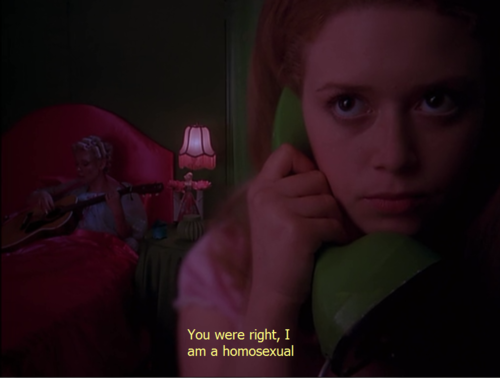
But I’m a Cheerleader is a 2000 satirical comedy directed by Jamie Babbit. This film follows the story of the typical suburban it-girl, Megan who has it all. She’s a blonde cheerleader with a smoking hot boyfriend and comes from a two-parent household. She’s got good grades and is religious. On paper, she is perfect. However, her life is turned upside down when her friends, parents, and boyfriend hold an intervention and send her off to a conversion therapy rehabilitation center called True Directions – she’s a lesbian, and although she doesn’t know it, everyone else does. They know she’s a lesbian because she doesn’t follow societal norms. There is a photo of a girl in a swimsuit in Megan’s locker – this becomes “evidence” of her lesbianism, in addition to her newfound vegetarianism and the fact that she looks bored as she kisses her boyfriend. Ironically, Megan finds her sexuality and herself in the very place trying to repress it. But I’m a Cheerleader satirizes that societal norms don’t define a person. The stereotypical gender roles True Directions teaches are simply social constructs. People cannot change the way that they are born, and no number of steps can turn someone into a heterosexual, although True Directions proposes five steps to heterosexuality.
The film begins with a cheerleading montage and we meet our main character, Megan, played by Natasha Lyonne. The audience is the first who knows that Megan is a lesbian as her queerness is evident when her boyfriend, Jared, begins kissing her and she looks painfully disinterested, and instead thinks about her fellow cheerleaders breasts during this stereotypical car make-out scene. The next day, the same happens except her boyfriend is very clearly stalling Megan by driving at a ridiculously low speed for the intervention to be prepared. Once Megan and Jared get to her home, she walks into a room full of her friends, family, and Mike from True Directions; Mike is an ex-gay True Directions employee played by RuPaul. This character choice fuels the repression that comes with conversion therapy. No one can truly be converted, but they can subdue their sexuality, their identity. The True Directions slogan is “Straight is Great.” However, when Megan gets here, she isn’t sure what is happening and why everyone is in her home. One by one, people from her life give examples of why she is a lesbian and she is taken to True Directions to be converted into a heterosexual woman. It is important to note the use of color in this scene – Megan is the only one in bright colors while everyone else is wearing a variation of brown or maroon. This makes her stand out from the rest and makes it clear to the audience that she is “different.” The only other person who isn’t wearing muted colors is Mike, who is wearing the same gear the audience will see him in for the rest of the film – blue short-shorts and his “Straight is Great” slogan tee. This pairs Megan and Mike together as outcasts.
Once Megan arrives, she’s stripped of her clothes and isn’t allowed to change from the hospital gown that Mary Brown, the owner of True Directions, gives her until she achieves the first step of becoming a heterosexual. The first step is admitting that you are homosexual. Megan is unable to do so and even uses bartering skills by saying, “I’m not perverted! I get good grades. I go to church. I’m a cheerleader!” This bartering technique further fuels the enforcement of gender roles imposed on us by society and religion. When her fellow rehabbers talk about the way she objectifies women’s bodies and doesn’t actually like kissing her boyfriend, nor does she get turned on by him, it is then that Megan first admits her homosexuality. She is a lesbian and she cries as she admits it. She is then given her pink shirt and skirt just like the other girls in the conversion center, and the boys wear blue outfits comprising of a shirt, shorts, and a tie. This plays into the further use of color that promotes stereotypical gender roles. Everything that the boys touch is blue and everything the girls touch is pink. The color scheme used throughout the film is very heteronormative and is constantly promoting the binary heterosexual agenda.
The following step to achieving your heterosexual dreams is rediscovering your gender identity. During this portion of their conversion experience, the rehabbers must learn how to follow their stereotypical gender roles. Megan and the rest of the girls are learning womanly things such as how to vacuum a carpet, how to sew and look good in a wedding dress, how to look like a straight woman, while the boys are learning how to fix a car, how to shoot a gun, and how to chop wood. The girls also learn how to change a baby’s diaper, since lesbians can’t possibly have children. Instead of focusing on these gender stereotypical acts, instead they focus on the blatant erotic nature of all these acts. Every time the boys are doing something, there is a phallic sculpture in the back of the screen – a wrench and a tree resemble the very thing they’re being trained to be against. Another sculpture shows a soldier on his knees in front of another soldier holding a gun near his crotch. The boys find themselves staring at Mike’s crotch and touching each other homoerotically, while the girls fantasize about Mary and graze each other’s breasts. During the second step, the rehabbers discus the roots of their homosexuality. Graham, who appears to be becoming Megan’s love interest, shares that the reason she is a lesbian is because her mother wore pants to her wedding and Hilary can blame an all-girls boarding school. Clayton is gay because his mother let him play in her pumps, Dolph touched one too many boys during wrestling and Joel was traumatized by a pair of breasts. Instead of the “born this way” mentality, this conversion therapy rehabilitation chooses to focus on the external factors that could’ve caused each rehabber to “become” a homosexual. This also fuels the ideology that there are gender-specific clothing items that if worn by the “wrong” gender would cause them feelings of misfit and homosexuality. Such an ideology is harmful for queer youth because it paints them to be immoral and This comes back during step four, during which the rehabbers must write an essay entitled “My Root and How It Prevented Me from Heterosexual Loving.”
The third step is family therapy. During family therapy, Megan finally discovers the root of her homosexuality. She is a homosexual due to the 9-month period where her father was out of a job and her mother had to provide for the family. Seeing her father emasculated this way, she lost her respect for men and gained a homoerotic respect for women. The fourth step is called “demystifying the opposite sex.” In order to “demystify” the opposite sex, Mary shows a plethora of images of 50’s housewives and explains that women are meant to be their husband’s better half entirely. Women cook, clean, and men touch women to make them feel good. While this lecture is happening, we see Megan and Graham start falling in love. Cue another montage of Megan and Graham interacting as partners would. When the rehabbers demystify the opposite sex, they instead demystify their own sex and learn how to do things properly. The women cook, clean, change diapers. This is a further fueling of rediscovering your gender identity, but with a kick – this time we realize that the things we do as women are done for men, and the things men do are done only for women. During this step, Jan discusses how she’s actually already heterosexual. There was a huge assumption that based on Jan’s shaved mohawk and her outward appearance, she was gay. However, this was not the case whatsoever. This is a prime example of how homosexuality, specifically lesbianism, is typecast into being softball players, or having to look a certain way. However, we are allowed to represent ourselves any way that we want to, we are allowed to show the world whatever image of ourselves we personally like and want to display. They face a final test during this stage, where they show off the skills they learned over the course of their rehabilitation. The girls set tables and clean, the boys play sports and fix cars. Long story short, girls do the girly things and boys do things that guys do. Megan finds herself being forced to leave during this step because Mary finds out about the secret relationship between her and Graham.
The fifth and final step is simulated sexual lifestyle in which the rehabbers must simulate a sexual desire for the opposite sex in order to graduate. Mary teaches them how to engage in heterosexual sex. Everyone looks quite bored, laying there expressionless, trying to convince themselves and Mary that they are no longer themselves. They are no longer their sexuality. This stripping of someone’s core identity can be detrimental to the queer youth perceived in this film, and essentially gives us an antithetical response to True Directions’ slogan – gay IS okay.
But I’m a Cheerleader ends with a graduation where the use of color is used again, this time to both provide a heterosexual agenda and a religious connotation. The rehabbers stay in their normal colors of pink and blue, while everyone else is in white. This seems like a scene of the rehabbers walking through the doors of heaven rather than in a graduation. Though Megan was kicked out of the program, she finds herself at graduation and the film comes full circle as she cheers Graham on into leaving behind this conversion center behind and running away with her. Queerness prevails.
This film is related to Queer Melancholia because of the loss of self that Megan must face when the label of her sexuality has been placed on her. For most people, coming to terms with their queer identity takes time and is an entirely internal struggle. However, in Megan’s case, she is not allowed that struggle because she is told what she is – she had never up until that point even realized that not all girls are like that. Megan adamantly refuses to disclose her status as she’s never thought of her homosexuality since, as a Christian, she doesn’t get hot and bothered by her boyfriend since she’s saving herself for marriage. Through the others in the rehabilitation center, she is able to see that not everyone has the same thoughts about women as she does. She is only able to admit her homosexuality after the others in group therapy sort of bully her into realizing that she’s a lesbian.
Personally, I discovered this film during a time in my life where I was struggling with my own sexual identity. This film was exactly what thirteen/fourteen-year-old Michelle needed to see in order to break the stereotypical gender roles and be able to assess my queerness. Because of the satirical nature of this comedy, it was easier to digest the message that people are going to try to stop you from being yourself. Certain people only care about morals. However, when you know who you are, nothing can stop anyone from determining your worth. Because Megan didn’t know who she was in the beginning, it was easier for people to get in her head and teach her what is right and wrong.
All in all, But I’m a Cheerleader played an important role in the representation of queerness in the media and definitely earned its cult status. The messages of queer identity and the struggles of coming to terms with your identity are prevalent in this film, just as in this course. Through Megan’s eyes, we see a loss of self but also an emergence of self as she discovers exactly who she is in a place that is attempting to suppress it.
Works Cited
But I’m a Cheerleader. Directed by Jamie Babbit. Lions Gate Films. 7 July. 2000.
“But I’m A Cheerleader in 2019: But Im a Cheerleader, Movie Quotes, Cheerleading Quotes.” Pinterest, 6 Dec. 2019, https://www.pinterest.com/pin/440719513515647184/.

