
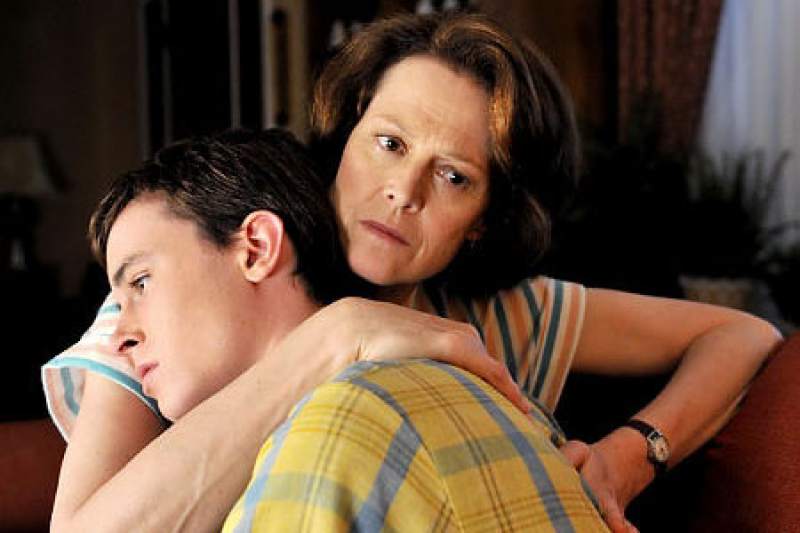
Prayers for Bobby is a 2009 film that depicts the issues that queer individuals face when their families learn of their homosexuality. The film is based on the 1995 book Prayers for Bobby: A Mother’s Coming to Terms with the Suicide of Her Gay Son by Leroy F. Aarons which recounts the real-life tragedy of Robert (Bobby) Griffith who committed suicide in 1983. The film’s protagonist, Bobby Griffith, is a high school student who lives with his devout Evangelical family in the late 1970s. Bobby is contemplating suicide when his older brother Ed walks in on him and begs him to tell him the reason for his distress. Bobby confides in his brother that he thinks he is gay and asks that he keep this a secret from his conservative family. Ed betrays Bobby and tells their mother, Mary, out of concern for his wellbeing. Mary immediately seeks to “cure” Bobby of the affliction of homosexuality. Mary sends Bobby to a psychiatrist and forces him to participate in various church activities as well as setting him up on dates with girls. Bobby’s father and siblings eventually accept Bobby’s homosexuality while his mother refuses to do so and instead fervently attempts to “cure” him. Bobby did everything Mary asked him to in an attempt to reconcile their relationship, but nothing he did was good enough. This eventually led him to become very withdrawn and depressed because of the guilt he felt from his mother’s homophobia. His self-loathing became unbearable, and Bobby ultimately committed suicide by jumping off a bridge. Mary cannot cope with the guilt she feels as she thinks she is responsible for Bobby’s death. She seeks comfort from her church but quickly realizes the prejudiced and homophobic preachings of her church are of no help to her. She reaches out to the LGBT community, particularly the Metropolitan Community Church, and eventually becomes a member of the Parents, Families and Friends of Lesbians and Gays (PFLAG) organization and fights against homophobia in Bobby’s honor. This film is a prime example of the psychological damage that rejection has on a queer individual and the obstacles that these individuals face in the pursuit of happiness within a homophobic society.
Bobby was not able to cope with his mother’s rejection and his psychological state deteriorated rapidly as a result. This is, unfortunately, something that many queer individuals experience as a result of the homophobic attitudes that surround them. In this particular film, the outcome is tragic and results in the death of a queer individual who was rebuffed by his mother despite his attempts to rationalize with her. He eventually reaches a breaking point and begs his mother to accept him for who he is. She refuses and she declares that she will not have a gay son to which he replies “Then you don’t have a son.” He then decides that his best option is to leave his home and make a new life for himself somewhere else where he does not have to feel constantly berated for being gay, but it quickly becomes obvious that he is not able to escape from her homophobia. After a year of constant homophobic preachings and remarks, Bobby had internalized this homophobia, making himself feel ashamed and guilty for being gay, making it impossible for him to find any solace in his new life away from his mother.
Bobby’s pursuit of happiness was thwarted by his mother’s homophobic crusade to “cure” him. Bobby was a once vibrant young man who had a great relationship with his family until he could no longer deal with denying his own identity. Prior to his coming out, Bobby and Mary had a loving relationship, his siblings even teased him for being his mother’s favorite child. This all changed drastically when Mary’s homophobic beliefs led her to push Bobby away. Her idea that she could “pray the gay away” through conversion and therapy only ruined Bobby’s mental and emotional health. She constantly reminded him that he would end up in hell if he did not change. Though Bobby attempted to be happy by leaving his mother’s home in California and building a new life for himself in Portland he was ultimately unable to distance himself from her homophobia. Bobby was living a seemingly pleasant life with his cousin but his mother would not let him live in peace. She continued to persecute him by sending him pamphlets that claimed AIDS was God’s punishment for homosexuality, leading Bobby to feel incapable of being happy. This inability to achieve happiness is a common theme present in other queer works such as James Baldwin’s Giovanni’s Room. The protagonist in this story, David, is unable to live the life he wants because of the ambivalent feelings that stem from his internalized homophobia. Homophobic society has a profound impact not only on the psyche of queer individuals but on their ability to pursue happiness as it denounces queer individuals as unworthy of obtaining real happiness or love.
The film depicts the severe impact that loss has on all individuals affected by homophobic attitudes. Throughout the film, we can see the love that Bobby has for his mother and the pain that he felt when he realized that she no longer loved him the way she did before. This feeling of loss contributed to the overwhelming psychological affliction that engulfed him and eventually led him to take his own life. There was one particular scene after Bobby’s death in which Mary is going through his belongings that I found to be a turning point in the film. She finds Bobby’s journal and reads the entries where he expressed his feelings of dejection and self-loathing as a result of her homophobia. He desperately wanted to win back his mother’s affection by doing everything he could to appease her, but nothing he did made him feel anything but rejection and hate on account of her religious beliefs. This is the moment in which Mary realizes that she was the catalyst in Bobby’s psychological turmoil and she sees the dangers of homophobia fueled by religion. She ultimately changes her ways and ends up fighting against the homophobic religious teachings she once staunchly defended. I found this aspect to be especially important because I see this behavior within my own Catholic family. They are very religious and often express their homophobic views which makes me angry not just at them, but at religion as a whole. It’s a difficult subject to address since religion can be a delicate subject but I’ve had many bad experiences with religion myself, as my parents forced me to attend retreats and prayer meetings for years, which led me to experience firsthand the bigotry and intolerant principles of religion. I think that Mary’s realization of the backward ideology preached by her own church is something that more people need to face particularly in this time where the LGBTQ community has gained more rights but is still suffering the impact of homophobia. It is important to realize that though we are living in a more progressive time, there continue to be individuals like Bobby who find themselves oppressed by homophobic families.
I think the fact that this is a true story makes the film even more impactful and makes the consequences of homophobia more genuine to the viewer. The pain that Bobby experienced as a result of his mother’s homophobia is palpable throughout the film and it emphasizes the message of the film. Mary’s radical change from rejection to acceptance is what strikes me as the most surprising element of the film. Religion is a central aspect of her and her family’s lives, it was something that brought them closer together until Mary used it as validation for her homophobia and rejection of her son. She was not able to realize the damage that it caused her son until it was far too late. Only after his death did she recognize the error of her ways and she sought to make things right by doing her part to prevent the spread of homophobia through religious teaching. I think the film conveys this message to its audience, some of whom may find themselves in the same predicament as Bobby as these feelings of melancholia and loss are experienced by many individuals upon coming out to their families. Homophobia continues to plague the LGBTQ community despite the progress made in the movement for equal rights. The psychological damage that rejection has on queer individuals needs to be addressed, particularly by conservative communities who consistently preach homophobic ideology. I think everyone, especially those who have a queer individual in their lives, needs to see this film in order to understand the tragic consequences of homophobia and the longlasting psychological trauma it inflicts on the queer community.
Works Cited:
- Aarons, Leroy F. “Prayers for Bobby.” YouTube, directed by Russell Mulcahy. 10 Dec. 2019, https://www.youtube.com/watch?v=sqIF50lSNVo.
- Holzberg, Ben Mark. Photograph of Mary (L, Sigourney Weaver) hugging Bobby (R, Ryan Kelley) from the Lifetime Original Movie, “Prayers for Bobby.” The Press Democrat, 23 Jan. 2009, https://www.pressdemocrat.com/news/2259867-181/lifetime-tv-to-show-film.
- Baldwin, James. “Giovanni’s Room.” Alfred A. Knopf, 2016.

