
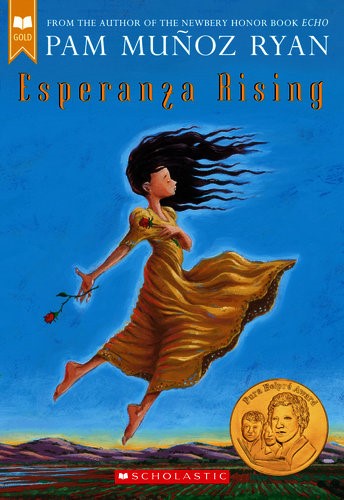
At first glance, Esperanza Rising by Pam Muñoz Ryan;2000; Book, is just seen as another children’s book, however, this novel has many layers to it that it goes beyond this expectation. The cover portrays a fair skin young girl, Esperanza de Ortega, whose long hair and yellow silk dress is flowing with the breeze. She is seen loosely holding a rose over a large plot of land that disappears in the distance, both the land and the rose hold much meaning in her life. I first came across this novel, thanks to the complicated system of school reading levels. Out of the limited number of novels that could have chosen from I chose Esperanza Rising. I saw myself in this novel, as if all that I had lust for at 12 years old was contained in this novel. However, what I would have not imagined that under many layers of meaning, hides a melancholic twist, as Esperanza mourns the death of her father throughout most of the book, she also mourns the loss of what her life used to be, developing a ambivalent relationship to the land, which in a way represent the changes in her life.
The novel depicts the life of Esperanza de Ortega, daughter of a wealthy landowner in Mexico, Sexto de Ortega who must go through different obstacles at a young age for her own as well as her family’s safety. The novel starts off describing Esperanza and her father connecting to the land, by attempting to hear its heartbeat. Ryan then goes on to explain the importance of the preparations for the harvest which terminate in Esperanza’s birthday. It is during this time that there is a large celebration in honor for Esperanza and the fruit harvested from the ranch. Up to this point Ryan, describes what happens every year and the illustrates happiness during this time. However, things get complicated when the Ortega family discovers that the head of the family, Sexto de Ortega has been killed.
This brings a variety of complications due Esperanza’s uncle who practically threatened the Ortega family if Esperanza’s mother, Ramona de Ortega does not marry him. To escape the threats, especially after the burning of their mansion Esperanza and Ramona decide to flee to California along with their former servants Alfonso, Hortensia, and Miguel. Esperanza’s grandmother had to stay in Mexico in a convent, as she healed from injuries caused by the fire. At such a young age, Esperanza experienced such a drastic life changed that affected her various ways, throughout most of the book she spends her time comparing of what her life once was and what she had to deal with now in the given circumstances, living in a Mexican labor camp. As she struggles with her own internal conflicts, she is faced with a much bigger issue in which her mother gets hospitalized and she is left to pay off medical expenses as well as for her grandmother’s voyage to California.
Melancholia can be seen creeping in here, beyond her father’s death but more precisely through the drastic changes she had to go through at 13 years of age. Her father represented what was good in her life and she lost all that when he left, at time she finds herself thinking what her father would have said of the living situation in the migrant camp if he was there. The death of her father goes beyond that just a loss of paternity for her, but it actually contributes to her loss of self. She compares what her life used to be when her father was around and what it is now especially when referring to birthdays. Esperanza explains how on her birthday there would be a process that would repeat each year from her favorite breakfast being served to the extravagant party thrown in her honor but the crucial part of each year where the porcelain dolls. Each year on her birthday she would receive one from her father. Esperanza treasures these dolls as she connects to them, she sees her own life reflected in their appearance. However, this now represents what her life will not be due to her given situation.
The land is also very important to consider here as it plays a crucial role in Esperanza’s persona. From a young age she develops a connection to the literal land and what it stands for, often seeking comfort and identity. Towards the middle of the book, Esperanza is seen falling into a deep state of melancholia, in which she begins question all that her life is and its worth stating, “Do you have some prophecy that I do not? I have lost everything. Every single thing and all the things that I was meant to be. See these perfect rows, Miguel? They are like what my life would have been. These rows know where they are going. Straight ahead. Now my life is like the zigzag in the blanket on Mama’s bed.” (Page 224) She begins feel once again these ties, the Ranch of Roses, her life, her plans, things that she has not brought herself to let go. Relocated in a migrant camp, she is safe and can start a new life but with everything going she can not help but develop an ambivalent relationship towards the land and her life in the United States.
Personally, I understand and relate to Esperanza’s melancholic views, since I had many transitions to due at a young age. Since I was very little I had to move from city to city and from country to country, leaving a piece of me within each place I went. This is something that immigrants from across the world can understand and relate to as well, as many of them are seen sacrificing everything that they are and have in search for a stable location to live a calm and safe life. They understand starting over, in a new place away from their traditions and what once was familiar to them leading them to overthink their past and incorporating this in their present lives instead of letting go.
It is surprising to find ideas such as melancholia in a children’s book and yet they are there in the catacombs of each dilemma. Esperanza’s struggles lead her to develop a melancholic relationship with the land and her new life in California, while mourning her life in Mexico as well as the death of her father. These ideas, however, are relatable to many especially the immigrant community and to those that lose themselves in the changes that life takes them.
Citation
Ryan Pam Muñoz. Esperanza Rising. Scholastic Press, 2018
“Esperanza Rising.” Booksource, www.booksource.com/Products/Esperanza-Rising__043912042X.aspx.

